
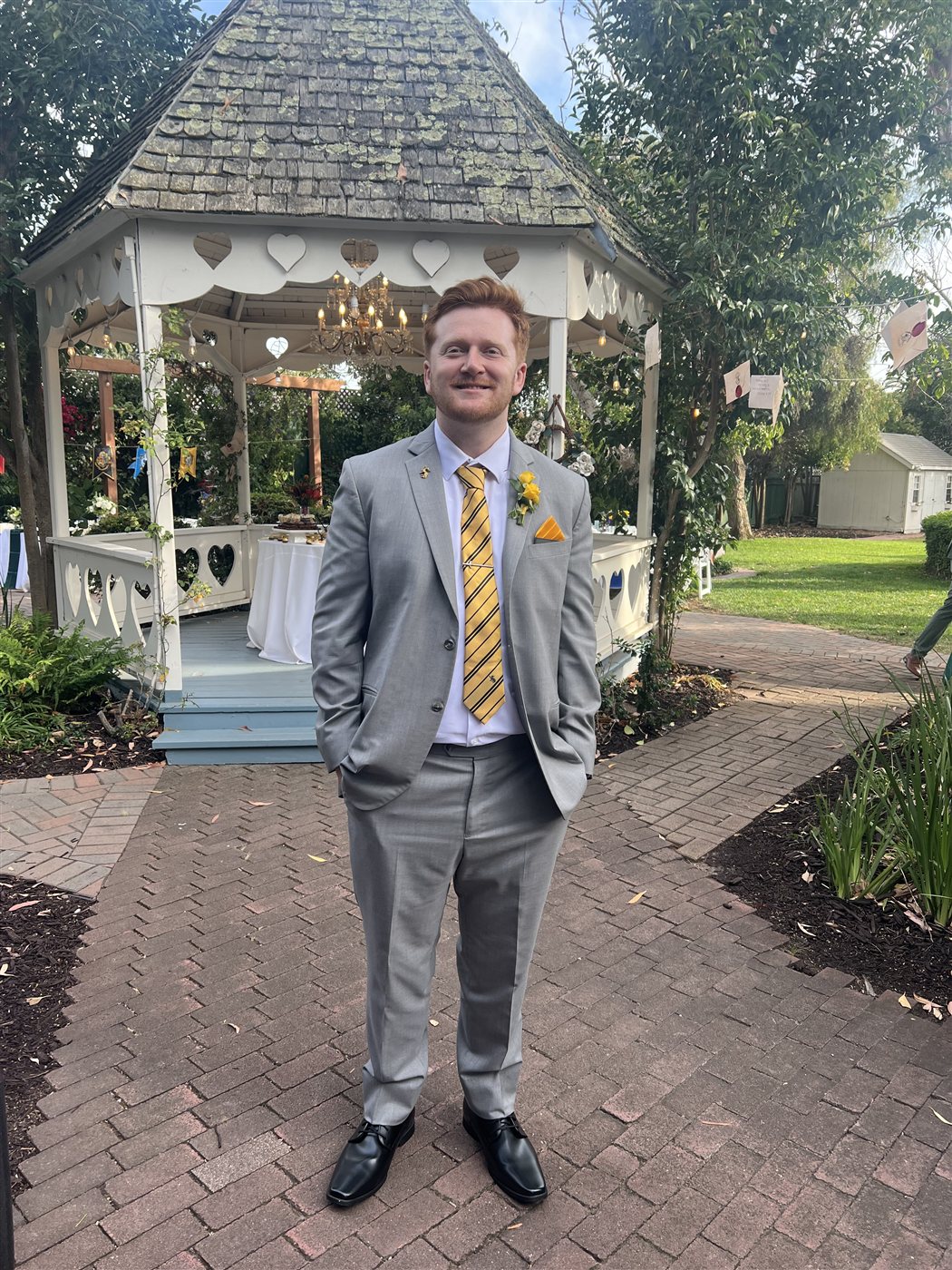
Hi, I'm Nick Pierini 👋
Ph.D. polymer chemist. I build the tools I wish I'd had at the bench.
Academic journey
I started out undeclared at Allan Hancock College, a community college in Santa Maria, CA. It wasn't exactly a straight line into a chemistry Ph.D., but it's where I got my footing. From there I transferred to Cal Poly San Luis Obispo for a B.S. in Biochemistry, where I worked in Dr. Philip Costanzo's lab synthesizing biocompatible polymers and collaborating with Sandia National Laboratories on scintillator development. It was my first real taste of polymer synthesis, and the thing that hooked me.
That led to a Ph.D. in Chemistry at the University of New Hampshire's Center for Sustainable Polymers, advised by Dr. Nate Oldenhuis. My dissertation work lived at the intersection of polymer chemistry and molecular biology: designing RAFT, ATRP, and ROMP agents for polymer grafting, building DNA hydrogels and nanostructures templated with DNA, and developing psoralen PEG conjugates for DNA 3D printing. It's also where I spent a lot of quality time with a Schlenk line, including the good, the tedious, and the "why won't this degas" moments.
Current work
Since 2024 I've been a Senior Scientist at Eastern Research Group, where I support Department of Defense research programs focused on advanced materials. I collaborate with government partners to develop and scale new formulations, taking projects from early bench work through full production, and I help write proposals for internally and externally funded research. It's taught me a lot about how a small assumption early on can compound once something moves to a larger scale.
Why I built this
Between grad school and my current work, I've run more ATRP, RAFT, ROMP, and free radical polymerizations than I can count, and I got tired of redoing the same feed ratio math and explaining the same lab technique every time. What started as a single calculator turned into the reference I actually wanted open in another tab: the mechanism schemes, the air free and conversion monitoring guides, a glossary for when I forget what dn/dc means at six in the evening, and a handful of extra tools I kept wishing existed, a copolymer composition calculator, a GPC calibration converter, a Tg predictor, and a full guide to reading a real chromatogram past just the Mn and Mw numbers.
If it saves you the five minutes of scratch paper arithmetic I used to do before every reaction, or the twenty minutes I've spent staring at a shouldering GPC peak trying to decide if it's real, it's done its job. And yes, there's a small maze game in here too. Not everything about polymer chemistry has to be serious.
Selected publications
- Pierini, N.; Paiva, W.; Dobbins, A.; Durant, O.; Wheeler, B.; Vesenka, J.; Oldenhuis, N. "Unimolecular DNA bottlebrush polymers with topologically defined, biodegradable backbones." Polym. Chem. 2025, 16, 2646 to 2658. doi.org/10.1039/D5PY00082C
- Hughes, S. M.; Aykanat, A.; Pierini, N. G.; Paiva, W. A.; Weeks, A. A.; Edwards, A. S.; Durant, O. C.; Oldenhuis, N. J. "DNA Intercalating Supramolecular Hydrogels for Tunable Thermal and Viscoelastic Properties." Angew. Chem. Int. Ed. 2024, 63, e202411115. doi.org/10.1002/anie.202411115
- Alameda, B. M.; Palmer, T. C.; Sisemore, J. D.; Pierini, N. G.; Patton, D. L. "Hydrolytically Degradable Poly(β Thioether Ester Ketal) Thermosets via Radical Mediated Thiol Ene Photopolymerization." Polym. Chem. 2019, 10 (41), 5635 to 5644.
Enjoying this?
This site is free to use and I plan to keep it that way. I build and maintain it on my own time because I wanted these tools to exist. If something here has ever saved you a headache and you feel like buying me a coffee, it's genuinely appreciated, but never expected.
☕ Buy me a coffee